
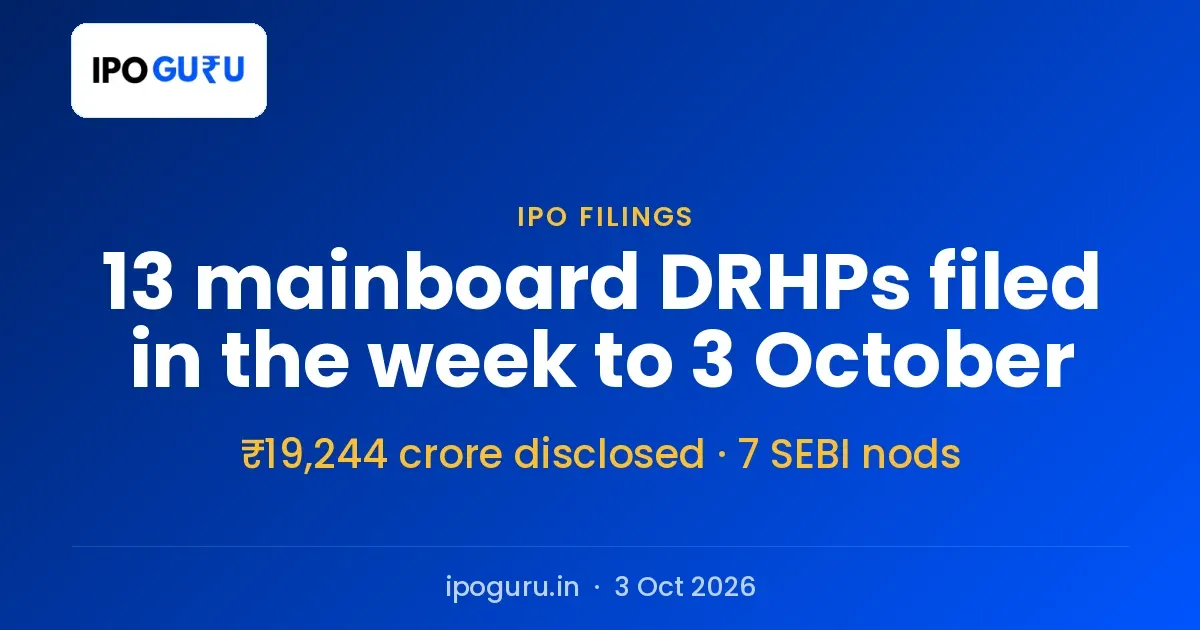
DRHP filings this week came from 13 mainboard companies, and 10 of them put a rupee figure on the offer: ₹19,244 crore between them. Seven more companies cleared SEBI's review in the same six working days to 3 October 2026. The biggest filing of the lot, Inox Clean Energy's ₹10,000 crore issue, was then kept in abeyance by the regulator.
A DRHP is the draft red herring prospectus, the first public document a company files with SEBI before an IPO. SEBI reads it, asks questions and eventually issues observations. Only after that can the company set a price band and open the issue. Filing a DRHP is the start of the queue, not the end of it.
Every mainboard DRHP filed in the week to 3 October
| Company | Issue size | Structure | Filed |
|---|---|---|---|
| Inox Clean Energy | ₹10,000 crore | ₹8,000 crore fresh, ₹2,000 crore OFS | 29 September |
| Inox Air Products | Not disclosed | 7.71 crore shares, all offer for sale | 30 September |
| JSW One Platforms | ₹3,054 crore | ₹1,300 crore fresh, ₹1,754.01 crore OFS | 2 October |
| Vishakha Renewables | ₹1,250 crore | ₹900 crore of it earmarked to repay debt | 30 September |
| Anarock Property Consultants | ₹1,000 crore | ₹550 crore fresh, ₹450 crore OFS | 1 October |
| B.S. Sponge | ₹1,000 crore | ₹650 crore of it earmarked to repay debt | 1 October |
| Royal Chain | ₹1,000 crore | ₹850 crore fresh, ₹150 crore OFS | 28 September |
| EverBrands India | ₹600 crore | Fresh issue only, no OFS | 29 September |
| Technopaints and Chemicals | ₹500 crore | ₹325 crore fresh, ₹175 crore OFS | 29 September |
| Arete22 | ₹440 crore | Split not disclosed | 29 September |
| J B Ecotex | ₹400 crore fresh | Fresh issue, OFS size not disclosed | 29 September |
| Kataline | Not disclosed | Fresh issue plus promoter OFS | 1 October |
| Ultravibrant Integrated Energy | Not disclosed | 1.45 crore shares | 2 October |
Read the structure column before the size column. That is where the money actually goes. In a fresh issue the company receives the cash and uses it for a factory, working capital or paying off loans. In an offer for sale, or OFS, existing shareholders sell their own shares and the company gets nothing.
Six of this week's filings disclosed a full split. Across those six, ₹11,625 crore is fresh issue and ₹4,529 crore is offer for sale. So about 72 per cent of that money reaches the companies themselves. That is a higher share than the pipeline usually shows, and it is mostly because two of the six are raising cash to cut borrowings.
Inox Clean Energy filed the biggest offer, then SEBI paused it
Inox Clean Energy, part of the INOXGFL group, filed on 29 September for ₹10,000 crore. The structure is ₹8,000 crore of fresh shares and a ₹2,000 crore OFS by promoter Devansh Jain. The company may also take up to ₹1,600 crore in a pre-IPO placement, which would cut the fresh issue by the same amount. About ₹6,000 crore of the proceeds is set aside to reduce debt.
The business has two legs: renewable power generation and solar manufacturing. Its renewable portfolio stood at 9.29 GW as on 31 August 2026, of which 2.37 GW was operational and about 0.80 GW under construction. In FY26 it reported revenue of ₹2,046.4 crore, EBITDA of ₹1,190.4 crore and net profit of ₹30.9 crore. The margin is wide and the profit is thin, which is what a heavy interest bill looks like on a power balance sheet.
Two days after the filing, SEBI added the company to its list of draft documents kept in abeyance, as reported by PTI on 1 October. Abeyance means the regulator has stopped the clock. It has not rejected the paper and it has not issued observations either. The file sits still until whatever SEBI wants resolved is resolved. JSW Cement's ₹4,000 crore draft spent time in abeyance in 2024 and came back; NSDL's did the same. So this is a delay of unknown length, not a verdict.
One number is worth holding on to. Of the ₹19,244 crore disclosed in filings this week, ₹10,000 crore is in this single offer. More than half the week's paper is currently on pause.
JSW One Platforms: ₹3,054 crore, and most of it to sellers
JSW One Platforms runs a business-to-business online marketplace for steel, cement and other building materials. It filed late on 1 October for ₹3,054 crore, split as ₹1,300 crore fresh and ₹1,754.01 crore OFS.
The sellers are named. Promoters JSW Steel and JSW Cement are offering ₹811 crore and ₹123 crore of shares. Japanese trading house Mitsui & Co is selling ₹820 crore worth. Of the fresh money, ₹500 crore goes into JSW One Finance to build its capital base, ₹350 crore into technology and the platform, ₹125 crore into JSW One Distribution for marketing, and the rest to general corporate purposes. JM Financial, Kotak Mahindra Capital, ICICI Securities, SBI Capital Markets and PL Capital Markets are the book-running lead managers.
The other two large ones are both offer-for-sale heavy. Inox Air Products, which we covered on 2 October, filed a pure OFS of 7.71 crore shares with no rupee value in the draft. Anarock Property Consultants, the real estate advisory firm, is raising ₹550 crore fresh out of ₹1,000 crore, with ₹148 crore of that going towards buying a stake in DSP.
Who cleared SEBI this week
Seven companies received SEBI observations, the formal go-ahead, in the same week. An approval is valid for 12 months, so these are the names that can realistically open an issue between now and October 2027.
- Jio Platforms: cleared along with completed roadshows, for an issue reported at ₹36,000 crore
- Carlsberg India: reported at about ₹6,600 crore, pre-filed confidentially in July
- Tonbo Imaging India: defence electronics, offering over 1.81 crore shares
- TMC Transformer
- Ujin Pharma
- Matangi Rubber
- Functional and Innovative Foods
Carlsberg, TMC Transformer, Ujin Pharma and Matangi Rubber were cleared as one batch on 1 October. Carlsberg's issue is reported to be entirely an offer for sale by the Danish parent, which means no new money for the Indian business.
Four companies filed where you cannot read the papers
Wadhwa Group Holdings, Dosti Realty, Moneytree Realty and Quadria-backed Maxivision all used SEBI's confidential pre-filing route this week. That route lets a company file without publishing the DRHP. The document only becomes public later, if the company decides to go ahead. Three of the four are real estate names. If you are tracking any of them, there is nothing to read yet and no size to quote.
What happens next
SEBI review normally runs one to three months from the filing date, so the companies that filed between 28 September and 2 October would get observations somewhere between late October 2026 and January 2027. Inox Clean Energy's timeline is now open-ended until the abeyance is lifted. The seven approved names have until roughly October 2027 to launch.
New DRHP filings and fresh approvals show up on our upcoming mainboard IPO list as they come in, and dates for issues already approved go on the IPO calendar. SEBI publishes its own filing and abeyance lists too, which is where the Inox Clean Energy status came from.
Frequently asked questions
What does it mean when SEBI keeps a DRHP in abeyance?
It means SEBI has paused its review without rejecting the draft. The company cannot receive observations or launch the IPO until the pause is lifted, and SEBI does not publish a deadline for that.
How long after a DRHP filing does an IPO open?
SEBI review usually takes one to three months, and once observations are issued the company has 12 months to launch. In practice the gap between filing and opening often runs four to nine months.
Which was the largest IPO filing in the week to 3 October 2026?
Inox Clean Energy, at ₹10,000 crore, with ₹8,000 crore as a fresh issue and ₹2,000 crore as an offer for sale by its promoter.