
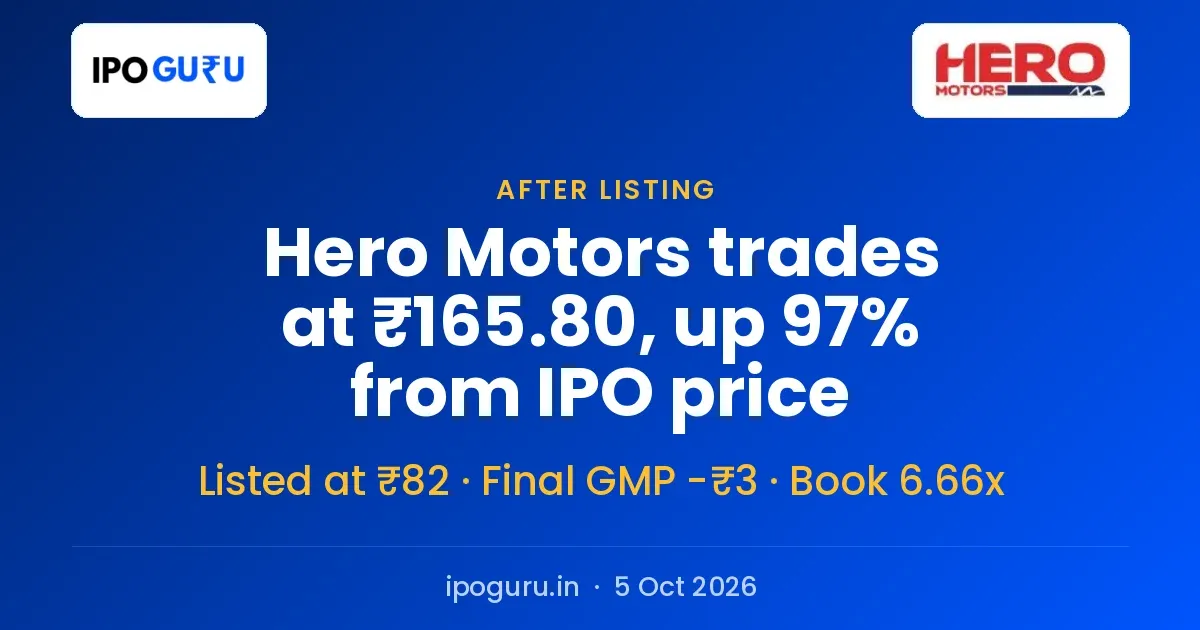
The Hero Motors share price was ₹165.80 on 5 October 2026, about 97 per cent above the ₹84 issue price. The stock had listed on 23 September at ₹82 on the NSE, below what IPO applicants paid. Twelve days later it is worth almost twice that.
The issue raised ₹1,000 crore, the 29th largest of the 99 mainboard IPOs that have closed in 2026. It was not a popular book. Total subscription was 6.66 times, which ranks 62nd of those 99.
The grey market read it the wrong way
On listing morning our tracker showed a grey market premium of minus ₹3, or 3.57 per cent below the issue price. Grey market premium is an unofficial dealer quote, not an exchange price, and that one pointed to a weak debut. The debut was weak. The shares opened at ₹82 on the NSE, a 2.38 per cent discount, which ranks 73rd of the 92 mainboard listings this year.
What the quote could not see was what came after. Across the last 10 mainboard listings, our data shows the final GMP missed the actual listing move by 8.28 percentage points on average, and it understated the move seven times out of ten. On the Hero Motors grey market premium page you can see the quote slide from ₹5.50 on 17 September to minus ₹3 by listing day.
Where the price stands
| Item | Figure |
|---|---|
| Issue price | ₹84 |
| Listing price, NSE, 23 September | ₹82 |
| Price on 5 October | ₹165.80 |
| Change vs issue price | +97.4% |
| Final grey market premium | -₹3 |
| Total subscription | 6.66x |
| One lot, 178 shares, now | ₹29,512.40 |
Who bid for it, and who did not
The category split explains why the listing was flat. Institutions barely turned up. The QIB portion was covered 1.49 times. The non institutional portion, the NII category where large and small high value bids sit, was booked 9.86 times, split 8.11 times for big NII and 13.36 times for small NII. Retail was 8.23 times, so roughly one retail application in eight got a lot. Once a portion is oversubscribed, allotment is a lottery, so that is an estimate and not a promise.
One lot was 178 shares, so the smallest application at ₹84 cost ₹14,952. Those same 178 shares were worth ₹29,512.40 at ₹165.80 on 5 October.
What has been reported about the rise
Business Standard reported on 1 October that the stock touched ₹167.45 that day, up 10 per cent on the BSE in intraday trade, with about 6.27 crore shares changing hands across the NSE and BSE. Brokerage notes quoted in that report pointed at the electric side of the business: products and services linked to electric vehicles were 23 per cent of FY26 revenue, against 12 per cent in FY24. Hero Motors makes powertrains, the parts that turn engine or motor power into movement at the wheels, for two wheelers, e-bikes, performance cars and heavy vehicles.
The price has moved a long way from the earnings behind it. At ₹84 the issue was priced at about 92.31 times post issue earnings, on an earnings per share of ₹0.91. On that same EPS, ₹165.80 works out to roughly 182 times. FY26 total income was ₹1,216.74 crore, up about 9 per cent, and profit after tax was ₹41.17 crore. Borrowings stood at ₹400.79 crore against a net worth of ₹482.45 crore.
What happens next
From here the price answers to results and order wins rather than to the IPO. The issue details, financials and the full subscription table stay on our Hero Motors IPO page, and where this listing sits against every other mainboard debut of 2026 is on the mainboard listing performance page.