
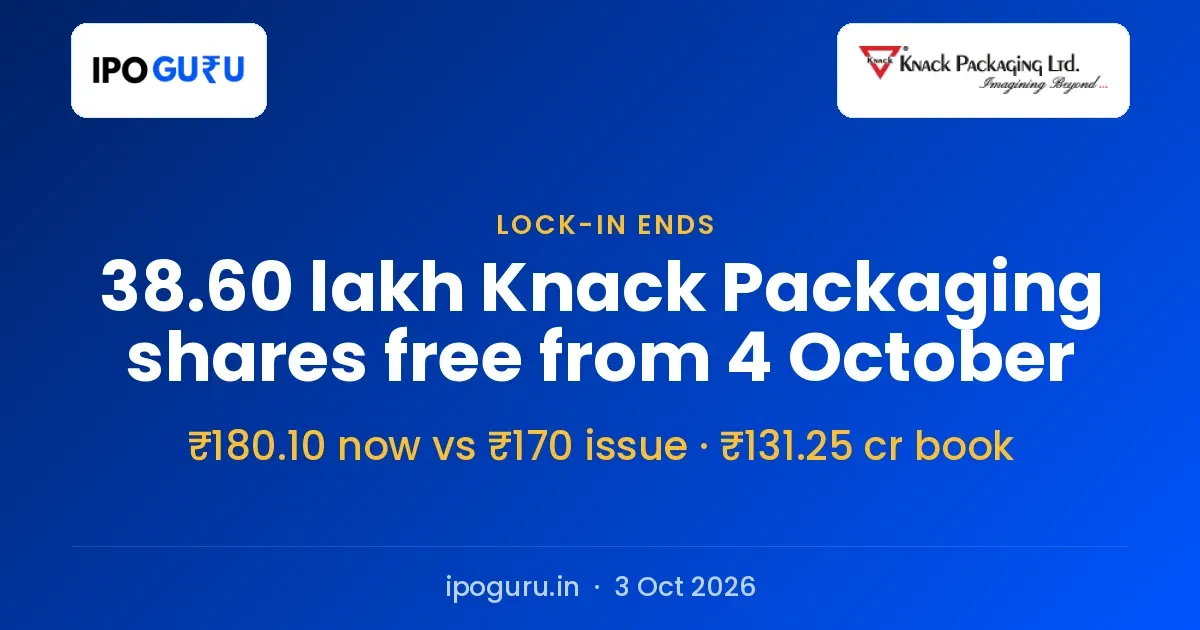
The Knack Packaging anchor lock-in ends on 4 October 2026 for the second and last tranche of shares its anchor investors bought. That is about 38.60 lakh shares, half of a 77,20,587 share anchor book. The stock last traded at ₹180.10 on 2 October, 5.94 per cent above the ₹170 issue price.
Anchor investors are the large institutions that buy a day before an IPO opens to the public. Their shares come with a lock-in: 50 per cent for 30 days from the allotment date and the rest for 90 days, under SEBI's rules for the anchor portion. Knack Packaging allotted shares on 6 July 2026. The first half came free on 5 August. The 90 day clock runs out on 4 October.
That date is a Sunday, so the first session in which these shares can change hands is Monday, 5 October. After that no part of the anchor book is locked any more.
What comes free to trade on 4 October
Here are the numbers behind the unlock, with the issue details from the Knack Packaging IPO page.
| Item | Figure |
|---|---|
| Shares allotted to anchor investors | 77,20,587 |
| Amount anchors paid | ₹131.25 crore |
| Price anchors paid | ₹170 a share |
| Share of the ₹439.5 crore issue | about 29.9 per cent |
| Came free on 5 August 2026 | about 38.60 lakh shares |
| Free to trade from 4 October 2026 | about 38.60 lakh shares |
| Last traded price, 2 October 2026 | ₹180.10 |
The anchor allocation was done on 30 June 2026, a day before the issue opened, and priced at the top of the ₹161 to ₹170 band. Business Today reported the book at ₹131.25 crore for 77,20,587 shares. Ashoka India Equity Investment Trust, SBI General Insurance, Bandhan Small Cap Fund, ITI Mutual Fund, Alchemy Long Term Fund and JM Financial Mutual Fund were among the names in it. Our own record for this IPO does not carry the anchor-wise split, so the per-investor shares are not shown here.
Where the stock stands against every earlier number
Knack Packaging listed on 8 July 2026 at ₹186, 9.41 per cent above the ₹170 issue price. It has drifted a little since. At ₹180.10 it is 3.17 per cent below that listing price and 5.94 per cent above the issue price. The anchors whose last shares open up on 4 October paid ₹170, so they are in modest profit after three months.
The grey market got the direction right and the size wrong, in both directions. Our tracker showed a premium of ₹26.50, or 15.6 per cent, on 3 July, the closing day. By listing morning it had fallen to ₹8.50, or 5 per cent, which pointed to an open near ₹178.50. The shares opened ₹7.50 higher than that. GMP is an unofficial dealer quote and not an exchange price, which is why we timestamp every reading.
The book itself was well covered. Our tracker put the ₹439.5 crore issue at 87.17 times overall: 160.22 times by QIBs, the institutional category, 146.64 times in the non-institutional category, 21.09 times by retail investors and 9.84 times by employees. Within the non-institutional half, big applications came in at 163.91 times and small ones at 112.09 times. You can see how the listing compares with other 2026 issues on our mainboard listing performance table.
What the company is doing with the money
The issue was ₹380 crore of fresh capital plus an offer for sale, so most of the money went to the company. ₹320 crore of it is going into a new manufacturing plant at Borisana in Kadi, Mehsana, Gujarat, with ₹31.15 crore kept for general corporate purposes and ₹33.37 crore for issue expenses. Knack Packaging reported total income of ₹843.77 crore and profit after tax of ₹92.72 crore in FY2026, against ₹747.38 crore and ₹73.81 crore the year before.
What a lock-in expiry actually means
It means those shares can now be sold. It does not mean they will be. Mutual funds disclose their holdings every month, so the October filings will show which of these schemes stayed on. Lock-in dates are set by the rules and are known from the day of allotment, so they are not a surprise to the market.
What happens next
With the 90 day tranche free from 4 October, Knack Packaging has no anchor shares left under lock-in. The same calendar is running for other recent issues, and we covered the ESDS Software lock-in that ended on 2 October. The anchor allocation figures used here come from the report published when the issue opened on 1 July 2026.