
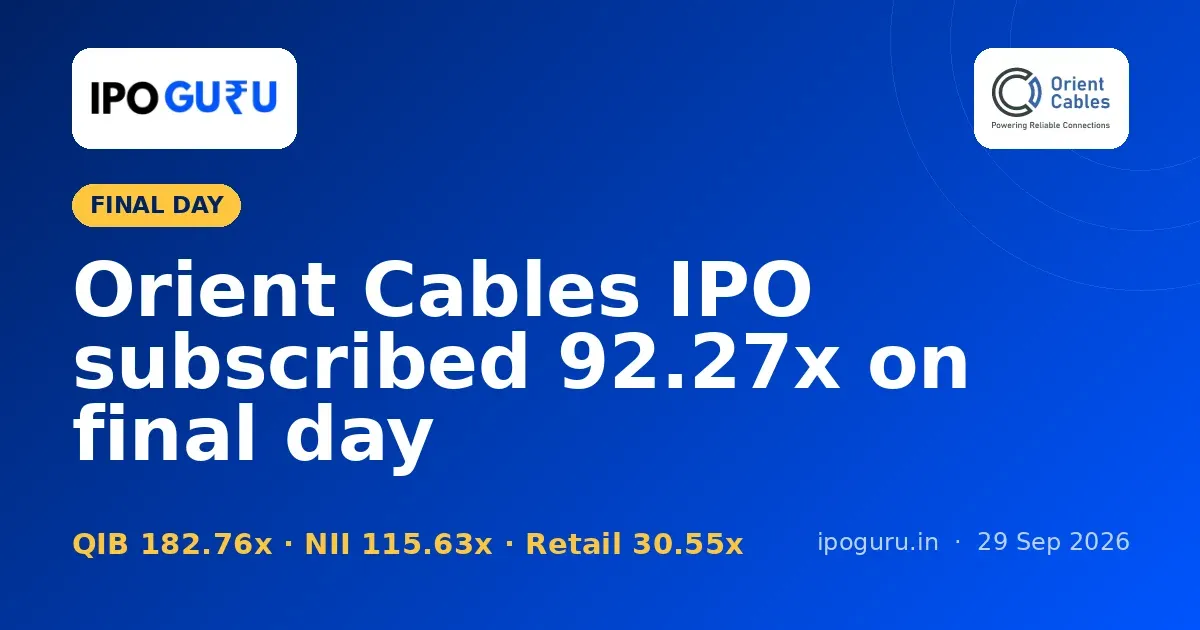
The Orient Cables IPO subscription status is final. The issue closed on 29 September with 92.27 times subscription on our tracker. Qualified institutional buyers bid 182.76 times their quota and retail investors bid 30.55 times. The 552 crore rupee issue is due to list on 5 October.
The final book, category by category
These are the closing figures from our Orient Cables subscription tracker, taken after bidding ended at 5 pm.
| Category | Times subscribed |
|---|---|
| QIB | 182.76x |
| NII (total) | 115.63x |
| bNII (bids above 10 lakh rupees) | 123.18x |
| sNII (bids of 2 lakh to 10 lakh rupees) | 100.53x |
| Retail | 30.55x |
| Total | 92.27x |
QIB means qualified institutional buyers, the mutual funds, insurers, banks and foreign funds that bid in a separate reserved pool. NII means non-institutional investors, which is everyone applying for more than 2 lakh rupees. The NII pool is split in two. bNII is the big half, for applications above 10 lakh rupees. sNII is the smaller half, from 2 lakh to 10 lakh rupees.
What the split says
Institutions led this book. At 182.76 times, the QIB figure is close to six times the retail figure of 30.55 times. Both halves of the NII pool crossed 100 times, so the big-ticket applicants stayed with the institutions rather than with retail.
Retail at 30.55 times is still a heavy oversubscription in absolute terms. It is simply the thinnest part of a very thick book. When all three categories run this far past their quota, the allotment stops being about how many lots you asked for and becomes a lottery.
What one application cost, and the allotment odds
The lot size is 55 shares. At the upper end of the 258 to 272 rupee band, one lot needed 14,960 rupees. That was the minimum a retail investor could put in.
The sNII category starts at 2 lakh rupees. At 272 rupees a share that means 14 lots, or 2,09,440 rupees, before you even enter that queue.
Retail closed at 30.55 times. In plain terms, retail investors asked for about 30 times the shares set aside for them. Under the basis of allotment every retail application for one lot goes into the same draw, so roughly one application in 31 can receive a lot. Applying for more lots does not improve those odds in an issue this heavily bid. The basis of allotment is the formula the registrar uses to decide who gets shares when demand runs past supply.
Where the 552 crore rupees goes
This is a fresh issue combined with an offer for sale. Of the 552 crore rupees, 320 crore rupees is fresh capital that reaches the company. The remaining 232 crore rupees is an offer for sale, which goes to the shareholders selling their stake, not into the business.
The company has earmarked 91.50 crore rupees of the fresh money for machinery, equipment and civil works at its plants, and 155.50 crore rupees to repay borrowings. The rest is for general corporate purposes. Promoter holding falls from 100 per cent to 82.17 per cent after the issue.
Sales up 42 per cent, profit flat
Orient Cables (India) makes networking cables and passive networking gear, the connectors, jacks and patch cords that carry a signal without drawing power. Its customers sit in broadband, telecom, data centres, renewable energy and building automation.
| Figure (crore rupees) | FY2024 | FY2025 | FY2026 |
|---|---|---|---|
| Total income | 664.98 | 831.86 | 1,181.67 |
| Profit after tax | 40.07 | 53.32 | 53.56 |
| EBITDA | 58.82 | 83.86 | 96.40 |
| Total borrowing | 36.73 | 113.45 | 234.19 |
Read the last two rows together. Income rose 42 per cent in FY2026, from 831.86 crore rupees to 1,181.67 crore rupees. Profit after tax barely moved, from 53.32 crore rupees to 53.56 crore rupees. Borrowing went from 36.73 crore rupees in FY2024 to 234.19 crore rupees in FY2026, and stood at 258.46 crore rupees on 30 June 2026 against a net worth of 268.76 crore rupees. That is a debt to equity ratio of 0.95.
For the quarter ended 30 June 2026 the company reported total income of 490.94 crore rupees and profit after tax of 32.78 crore rupees. At the 272 rupee issue price the shares are valued at 23.61 times earnings on an EPS of 11.52 rupees, for a market capitalisation of 3,095.35 crore rupees.
What the grey market is saying
Our Orient Cables GMP tracker showed a premium of 77 rupees at 6.36 pm on 29 September, or 28.31 per cent over the 272 rupee issue price. That points to a listing near 349 rupees.
| Date | GMP (rupees) | Over issue price |
|---|---|---|
| 25 September | 80 | 29.41% |
| 26 September | 86 | 31.62% |
| 27 September | 90 | 33.09% |
| 28 September | 72 | 26.47% |
| 29 September | 77 | 28.31% |
The premium peaked at 90 rupees on 27 September, fell to 72 rupees the next day and recovered to 77 rupees on closing day. GMP is an unofficial quote between private dealers. It is not an exchange price, nobody publishes an order book for it, and it can change hours before listing. Treat it as a mood reading, not a forecast.
What happens next
The basis of allotment is due to be finalised on 30 September 2026. Refunds start on 1 October and shares should reach demat accounts the same day. Listing on both BSE and NSE is set for 5 October 2026.
KFin Technologies is the registrar for this issue. IIFL Capital Services and JM Financial are the book running lead managers. Once the registrar opens the allotment window on 30 September you can look up your application through our guide to checking IPO allotment status, using your PAN or application number.
Frequently asked questions
What is the Orient Cables IPO lot size and minimum investment?
One lot is 55 shares. At the upper band of 272 rupees that works out to 14,960 rupees for a single retail lot.
When is the Orient Cables IPO allotment date?
The basis of allotment is expected to be finalised on 30 September 2026, with refunds and demat credit on 1 October 2026.
How much did QIBs bid in the Orient Cables IPO?
The QIB category closed at 182.76 times, the highest of any category. The total book finished at 92.27 times.