
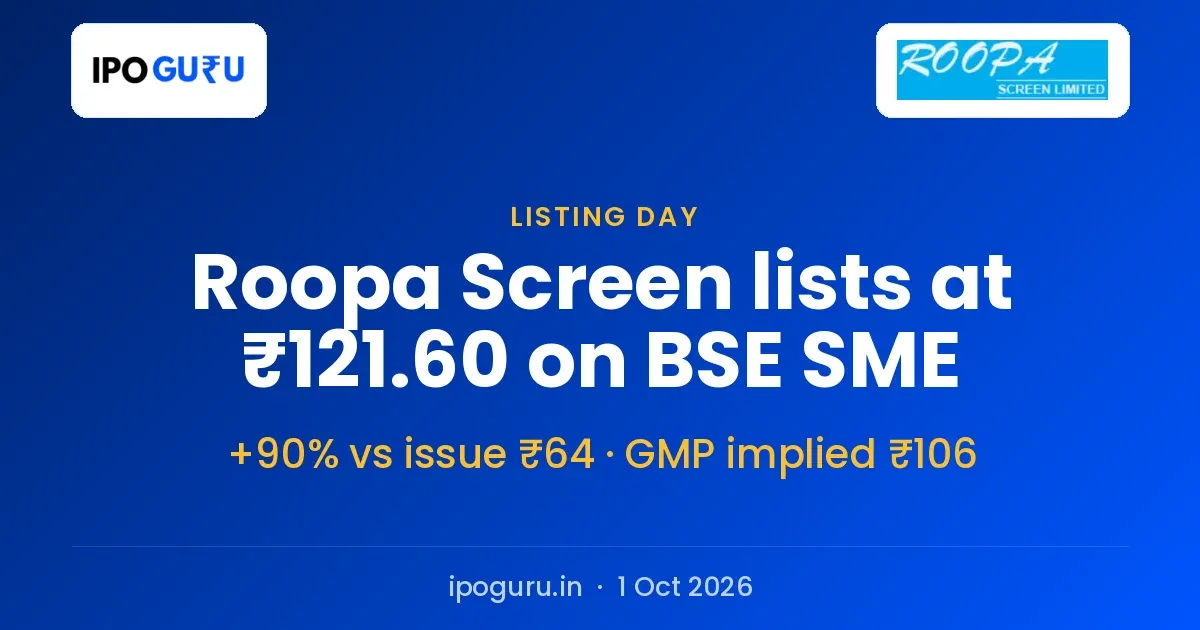
The Roopa Screen IPO listing price is ₹121.60 on the BSE SME platform. The issue price was ₹64, so the shares opened 90 per cent higher on 1 October 2026. The grey market had priced a smaller gain than that.
The issue itself was tiny. Roopa Screen raised ₹19.20 crore, all of it fresh capital, with no offer for sale. The book closed at 252.98 times on 28 September. Retail was the loudest part of it, at 529.82 times.
What the grey market got wrong
GMP is the grey market premium, an unofficial price that dealers quote for IPO shares before they list. It is not an exchange price and nobody is obliged to honour it. Our tracker had Roopa Screen at ₹42 on the morning of 1 October, which is 65.62 per cent over the issue price.
₹64 plus ₹42 is ₹106. The stock opened at ₹121.60. The grey market was ₹15.60 short of the first trade.
The premium had been climbing all through the week. Read the last column as the price the grey market was pointing to.
| Date | GMP | Premium over ₹64 | Implied price |
|---|---|---|---|
| 26 September 2026 | ₹32 | 50.00% | ₹96 |
| 27 September 2026 | ₹32 | 50.00% | ₹96 |
| 28 September 2026 | ₹38 | 59.38% | ₹102 |
| 29 September 2026 | ₹38 | 59.38% | ₹102 |
| 30 September 2026 | ₹42 | 65.62% | ₹106 |
| 1 October 2026 | ₹42 | 65.62% | ₹106 |
So the direction was right and the level was not. You can follow the same numbers on our Roopa Screen GMP history page, which is where these quotes are dated and stored.
How the book was built
252.98 times overall is the headline number, but the split tells you more. Here is how each category bid by the close on 28 September.
| Category | Subscribed |
|---|---|
| QIB (banks, funds and other institutions) | 44.81x |
| NII (non institutional, the high value applications) | 281.63x |
| bNII (bids above ₹10 lakh) | 429.87x |
| sNII (bids of ₹2 lakh to ₹10 lakh) | 407.57x |
| Retail | 529.82x |
| Total | 252.98x |
Retail asked for about 530 times the shares kept aside for it. When an SME book goes that far past its reserved portion, allotment stops being a calculation and becomes a draw: the registrar runs a lottery and most applicants get nothing. Bigshare Services was the registrar here.
The two large investor buckets were also past 400 times each, which is why institutional demand at 44.81 times looks modest by comparison. It was not weak in absolute terms. It was simply the quietest room in a very loud building.
What one lot cost, and what it opened at
The lot size was 2,000 shares. At the upper band of ₹64 that is ₹1.28 lakh for a single application, which is the usual SME entry ticket and the reason these issues are not for small budgets.
At the listing price of ₹121.60, those same 2,000 shares were valued at ₹2.43 lakh at the open. That is the arithmetic of a 90 per cent listing. It is also why the price band at ₹60 to ₹64 now looks like the least interesting number in the story.
What the company actually does
Roopa Screen was set up in 2013 and makes rotary nickel screens. A rotary nickel screen is a cylindrical perforated metal sleeve that works as a stencil. Printing paste is pushed through the holes onto fabric moving underneath, and the pattern of holes decides the design. Because the sleeve keeps rotating, the fabric never has to stop, which is what makes high volume textile printing possible.
It sells under four product lines and also trades nickel cathodes, the raw material its screens are made from. In FY2026 it supplied more than 200 customers across India, with most revenue from Gujarat, Maharashtra, Haryana, Punjab and Tamil Nadu. Every sale is business to business, to textile printing units.
| ₹ crore | FY2024 | FY2025 | FY2026 |
|---|---|---|---|
| Total income | 35.85 | 45.63 | 51.32 |
| EBITDA | 4.24 | 8.13 | 10.00 |
| Profit after tax | 1.50 | 4.69 | 6.48 |
| Net worth | 5.21 | 9.89 | 16.37 |
Profit has more than quadrupled in two years. At the ₹64 issue price the shares were offered at 10.92 times post issue earnings of ₹5.86 a share, which was among the cheaper tags in the recent SME batch. Pricing an issue below where the market is willing to pay is one explanation for a 90 per cent open.
The money is spoken for. ₹9.90 crore goes into a new manufacturing facility, ₹6.00 crore into working capital and the rest to general corporate purposes. A new plant takes time to build and longer to earn, so that part of the story is still ahead. Promoter holding falls from 87.4 per cent to 63.71 per cent after the issue.
What happens next
The dates are all behind us now. Allotment was finalised on 29 September 2026, refunds and demat credit were on 30 September, and listing was on 1 October. From here the shares trade on BSE SME like any other scrip, with one caveat worth remembering: SME counters are thin, the minimum trading lot stays large, and a wide open can narrow quickly in the sessions that follow.
The full file on this issue, including the final allotment and the day one price, sits on our Roopa Screen IPO page. For how this open compares with the rest of the year, our SME IPO listing performance table keeps every listing gain and loss in one place.
Frequently asked questions
What is the Roopa Screen IPO listing price?
₹121.60 on the BSE SME platform on 1 October 2026, against an issue price of ₹64. That is 90 per cent above the issue price.
How much was the Roopa Screen IPO subscribed?
252.98 times overall. Retail bid 529.82 times, NII 281.63 times and QIB 44.81 times.
What was the Roopa Screen IPO lot size and minimum amount?
2,000 shares in one lot, which is ₹1.28 lakh at the upper band of ₹64.