
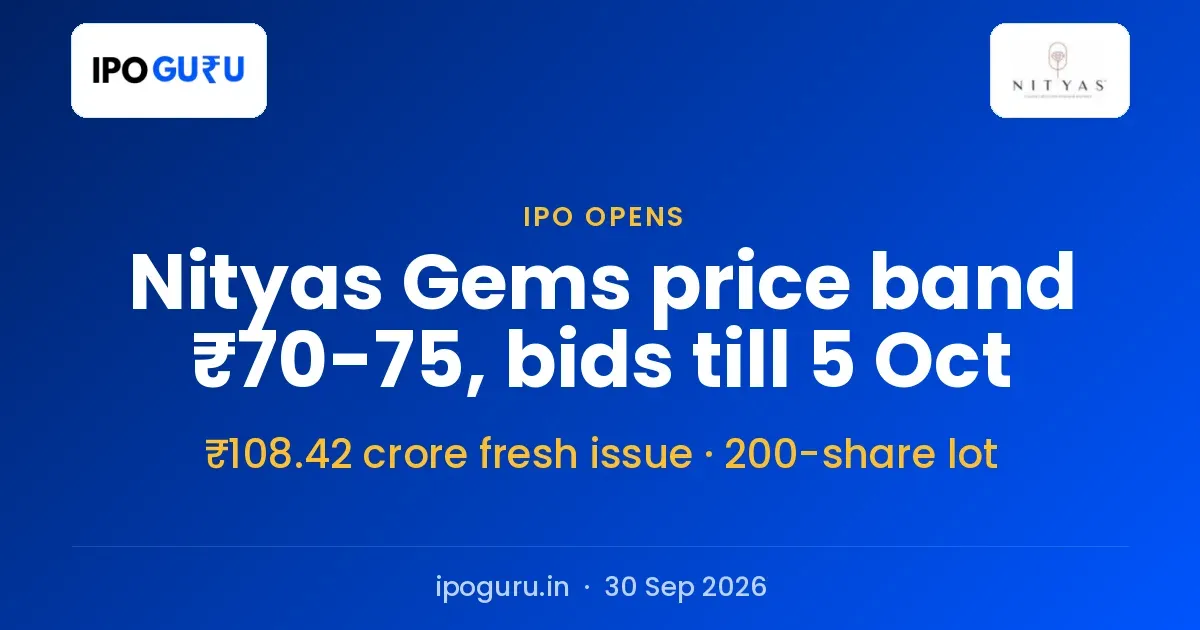
The Nityas Gems IPO opened for bidding on 30 September 2026. Nityas Gems & Jewellery is selling 1.44 crore new shares at ₹70 to ₹75 each, which comes to ₹108.42 crore at the upper band. One lot is 200 shares, so the smallest application at ₹75 costs ₹15,000.
Update, 6 October 2026: allotment day and the final book
The Nityas Gems IPO allotment status is due on 6 October 2026. Bigshare Services is the registrar for the issue, so the status shows up on the registrar's allotment page and on the application-status pages of the BSE and the NSE once the basis of allotment is approved. You need your PAN or your application number to check it.
The book closed at 2.25 times on 5 October. Retail led with 4.04 times. Non-institutional investors put in 2.05 times and qualified institutional buyers, the mutual funds, insurers and foreign funds who bid in the QIB slice, took 1.06 times. The employee portion was booked 2.82 times.
| Category | Times subscribed |
|---|---|
| Qualified institutional buyers | 1.06x |
| Non-institutional investors | 2.05x |
| Of which bids of ₹2 lakh to ₹10 lakh | 3.02x |
| Of which bids above ₹10 lakh | 1.56x |
| Retail | 4.04x |
| Employees | 2.82x |
| Overall | 2.25x |
Read the retail line first. At 4.04 times, roughly one retail application in four picks up a lot. That is an estimate and not a rule. Once a portion is oversubscribed the allotment is a computerised draw, and extra lots in a single application do not improve the odds.
At 2.25 times overall this is the 78th most subscribed of the 99 mainboard IPOs that have closed in 2026. The median book this year is 24.96 times, so demand here sat well below the average issue.
Refunds and demat credits are dated 7 October. Trading starts on 8 October on both exchanges. Our tracker showed a grey market premium of ₹1, or 1.33 per cent over the ₹75 issue price, at 9 AM on 6 October. It was ₹3 on 3 October and ₹5 on 30 September. The premium is a dealer quote outside the exchanges, not a price anyone can trade at, and on the last 10 mainboard listings the final premium was off by 10.38 percentage points on average.
The numbers in one place
| Detail | Value |
|---|---|
| Price band | ₹70 to ₹75 a share |
| Issue size | ₹108.42 crore, all fresh shares |
| Lot size | 200 shares |
| Minimum at ₹75 | ₹15,000 |
| Bidding | 30 September to 5 October 2026 |
| Allotment | 6 October 2026 |
| Listing | 8 October 2026, BSE and NSE |
| Grey market premium | ₹5 on 30 September |
You can follow the dates and the live figures on our Nityas Gems IPO page.
Where the money goes
There is no offer for sale here. An offer for sale is the part of an IPO where existing shareholders sell their own shares and keep the cash. Nityas Gems has none of that, so every rupee raised goes to the company.
About ₹70 crore of the amount is earmarked for working capital. The rest is for general corporate purposes. Working capital matters in this trade because gold and diamond stock ties up money for months before it turns into a sale.
What the company does
Nityas Gems makes gold jewellery studded with lab-grown diamonds. Most of it goes to jewellery retailers and wholesalers. It also sells directly to buyers through its subsidiary brand Aayaani.
Revenue was ₹53.66 crore in FY24, ₹96.85 crore in FY25 and ₹202.89 crore in FY26. Profit after tax moved from ₹4.02 crore to ₹9.79 crore to ₹22.32 crore over the same three years. Revenue has more than doubled in a single year.
At ₹75 a share the company is valued at roughly ₹432 crore. Set against FY26 profit of ₹22.32 crore, that is about 19 times last year's earnings.
What the grey market is quoting
Our tracker showed a premium of ₹5 on 30 September, or 6.67 per cent over the ₹75 upper band. It was ₹9 on 28 September and zero on 26 and 27 September, when dealers had not started quoting the issue. So the number has already halved in two days.
Treat it for what it is. The grey market premium is an unofficial quote between dealers outside the exchanges. It is not a price you can trade at and it has no bearing on where the share actually opens on 8 October. Our live GMP page records the daily movement for every open issue.
How much is reserved for retail
Half the issue is set aside for qualified institutional buyers, 35 per cent for retail and 15 per cent for non-institutional investors. The retail slice works out to roughly ₹38 crore, or about 25,000 lots at ₹15,000 each. If retail applications cross that count, allotment is decided by a computerised draw, and extra lots in one application do not improve the odds.
In the opening hours of 30 September the book stood at 0.08 times overall on our mainboard subscription table. Bidding stays open until 5 PM on 5 October, so that figure will move a great deal before the final count.
What happens next
Bidding closed on 5 October 2026 at 2.25 times. The allotment is dated 6 October, refunds and demat credits 7 October, and trading starts on 8 October on both BSE and NSE. Money blocked in UPI mandates is released for applications that do not get shares. We will add the listing price on 8 October.