
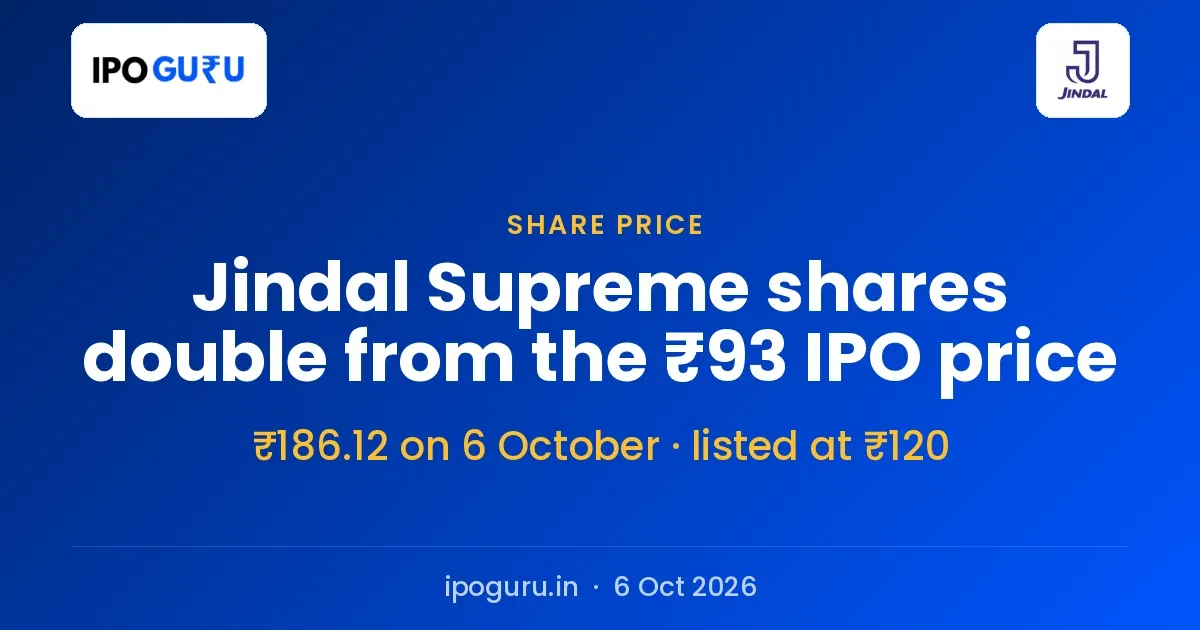
The Jindal Supreme share price is ₹186.12 on our tracker as on 6 October 2026. That is exactly double the ₹93 IPO price. The steel pipe maker listed on 23 September at ₹120, a 29.03 per cent premium, and has kept moving up since.
What ₹14,973 in the IPO is worth now
One lot in this IPO was 161 shares. At the upper band of ₹93 that cost ₹14,973. The same lot is worth ₹29,965 at ₹186.12. The gain works out to ₹14,992 a lot in 13 days.
Here is the whole journey in one table.
| Stage | Price | Vs issue price |
|---|---|---|
| IPO price band | ₹88 to ₹93 | Issue price ₹93 |
| Listing open, 23 September | ₹120 | +29.03% |
| Price on 6 October | ₹186.12 | +100.13% |
The valuation has doubled with the price. At ₹93 the issue was priced at 14.33 times earnings, on earnings per share of ₹6.49. At ₹186.12, the same ₹6.49 works out to about 28.7 times. Post issue market capitalisation was ₹474.52 crore at the issue price. It is near ₹950 crore now.
The grey market nearly got this one right
Our last grey market reading before listing was ₹29, or 31.18 per cent, on 23 September. The shares opened at a 29.03 per cent premium. The grey market was off by just over two percentage points, which is unusual. Across the last 10 mainboard listings our data shows the final GMP missed the actual open by 10.68 percentage points on average. It overstated the gain six times out of ten.
GMP is an unofficial quote from grey market dealers, not an exchange price, and it says nothing about where a stock goes after listing day. In this case the grey market called the open and then the stock went on to add another 55 per cent on top.
A small issue with a very big book
At ₹124.88 crore, this was the 95th largest of the 99 mainboard IPOs that closed in 2026. The demand did not match the size. The book closed at 181.07 times, the sixth most subscribed mainboard IPO of the year against a median of 24.96 times.
The split shows where it came from. Non institutional investors bid 327.99 times, with the small NII slab at 375.61 times and the big ticket slab at 304.18 times. Retail came in at 149.34 times and institutions at 126.41 times. Retail demand at that level means roughly one application in 149 got a lot, which is an estimate rather than a rule, since allotment is a lottery once a category is oversubscribed. You can see the full category wise subscription for Jindal Supreme on our page for the issue.
The business behind the number
Jindal Supreme (India) has made steel pipes and tubes since March 1974. Its range covers mild steel black pipes, galvanised pipes, metal beam crash barriers for highways and galvanised iron tubular poles for street lighting. It sells to infrastructure contractors and industrial buyers, and runs a single plant at Hisar in Haryana.
Total income was ₹675.94 crore in FY2026, up from ₹604.74 crore. Profit after tax went the other way, down to ₹22.53 crore from ₹24.27 crore. Of the ₹124.88 crore raised, ₹71 crore was earmarked to repay borrowings, which stood at ₹119.87 crore as on 31 March 2026. Promoters Abhishek Jindal and Sonam Jindal came down from 100 per cent to 73.68 per cent.
What happens next
There is no IPO milestone left here. The allotment was on 21 September, refunds and demat credit on 22 September, and listing on 23 September on both the BSE and the NSE. From here it is a results story, with the September quarter numbers due later this month.
Price, financials and the full issue history sit on our Jindal Supreme (India) IPO page. For how this open compares with the rest of the year, our mainboard IPO listing performance table ranks every 2026 debut. A 29.03 per cent open was the 22nd best of 98 mainboard listings this year, where the median gain was 7.04 per cent.