
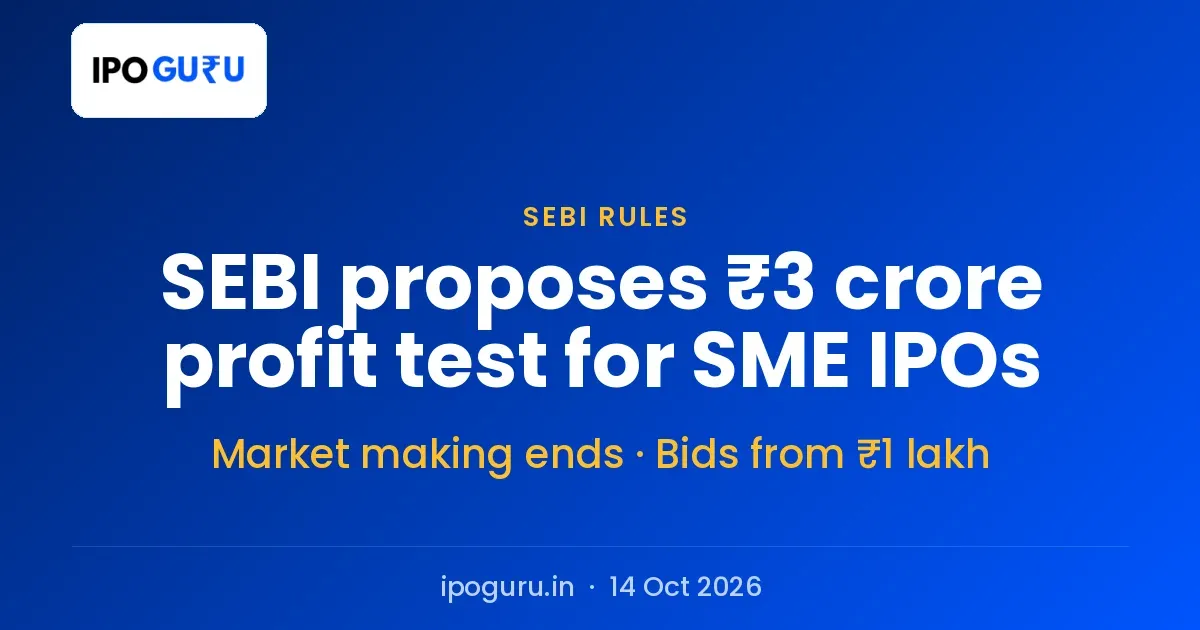
SEBI has proposed new SME IPO rules in a consultation paper dated 14 October 2026. A company would need average annual operating profit of ₹3 crore over three years, up from ₹1 crore in two of three years. Public comments are open until 4 November.
What would change for companies?
Eligibility would move from paid-up capital to market value. A company with a post-issue market capitalisation of up to ₹1,000 crore could list only on an SME platform. One between ₹1,000 crore and ₹4,000 crore could choose SME or mainboard. One above ₹4,000 crore at the offer-document stage would have to refile under the mainboard framework.
A company that misses the profit test could still come through a second route. It would have to use book building and give at least 75% of the net offer to qualified institutional buyers, the large funds and banks. If that allocation falls short, all the money is refunded.
| Item | Now | Proposed |
|---|---|---|
| Profit test | ₹1 crore operating profit in 2 of 3 years | ₹3 crore average over 3 years |
| Minimum application | Above ₹2 lakh | ₹1 lakh, at least four lots of ₹25,000 each |
| Minimum allottees | 200 | 500 |
| Non-promoter pre-IPO lock-in | 1 year | 6 months |
| Market making | Compulsory | Removed |
| Trading lot | Set by exchange lot | 1 share |
What changes for people who bid?
The minimum application value would fall to ₹1 lakh from above ₹2 lakh. The number of allottees an issue must reach would rise from 200 to 500. Retail allotment would no longer have to be in multiples of the minimum lot, subject to availability.
After listing, the trading lot would shrink to one share. Compulsory market making, where a designated firm quotes buy and sell prices, would go, along with its inventory rules. Whether trading becomes easier or thinner without it is not something the paper settles.
Which other rules are touched?
- Offer for sale: a dedicated framework with a one-year holding period for shares offered, with exemptions. QIB sellers could be exempt from the 20% issue cap and 50% pre-issue holding cap.
- Underwriting: the 100% underwriting rule and the lead manager's extra 15% would go. Mainboard norms and a 90% minimum subscription would apply.
- Use of money: the ₹10 crore cap on general corporate purposes would go. The 15% limit stays.
- Lock-ins: minimum promoter contribution stays locked for three years from allotment. Excess promoter holding would be locked for one year.
- Migration: voluntary to the mainboard from ₹1,000 crore, mandatory at ₹4,000 crore, and no route back from mainboard to SME.
SEBI says 1,496 companies had listed on SME platforms by 31 July 2026, and 365 of them had moved to the mainboard. SME IPOs had raised ₹40,222 crore. The proposals would have a three-month transition period, as reported by CNBC-TV18.
What our data shows
Our records for 2026 show 184 SME issues closed and ₹8,306 crore raised, against ₹1,22,663 crore across 100 mainboard issues. Of 170 SME listings, 92 opened above the issue price. The median SME listing gain is 0.72%, against 6.93% for mainboard. You can check the full record on our SME IPO performance page and compare it with mainboard listings.
What happens next
This is a proposal, not a rule. SEBI takes comments until 4 November 2026 and then decides whether to adopt it. Any final rule is expected to come with a three-month transition. Current and upcoming issues are listed on our SME IPO page.