
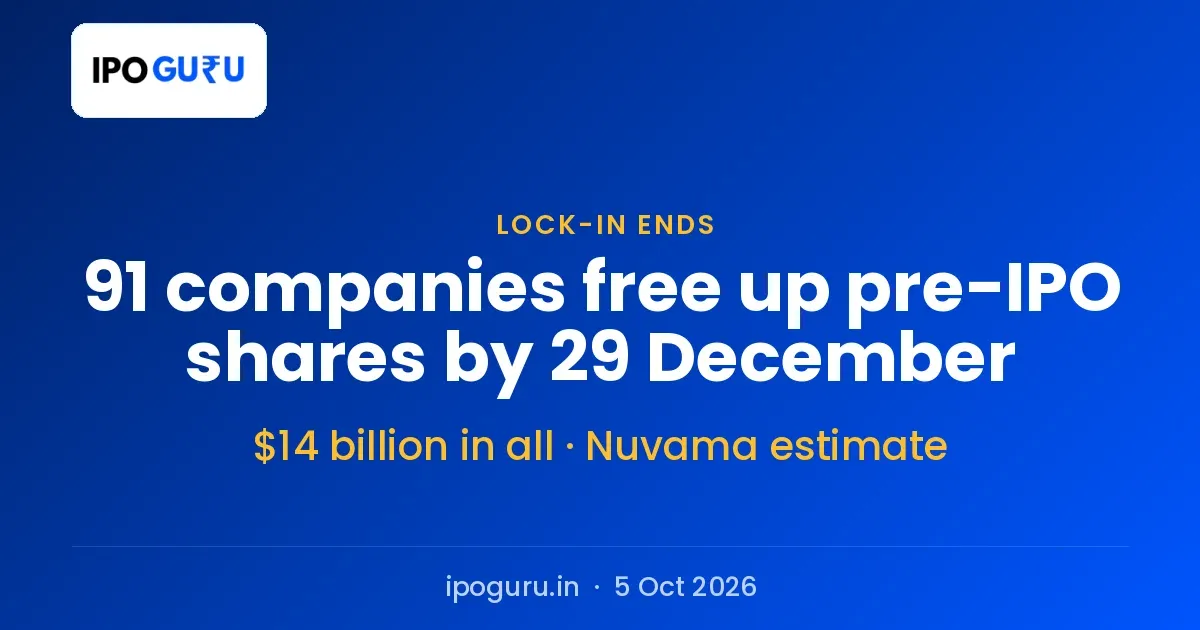
Lock-ins on pre-IPO shares in 91 listed companies expire between 5 October and 29 December 2026. Those shares are worth about $14 billion, as per an estimate from Nuvama Alternative & Quantitative Research reported by The Economic Times on 5 October. An IPO lock-in expiry only makes shares eligible to be sold. It does not mean they will be sold.
That second part is the whole story. The headline number looks large because it adds up everything that comes free, including the holdings of promoters who have no intention of exiting.
What a lock-in is, in one paragraph
When a company lists, the shares bought before the IPO cannot be traded straight away. Promoters, private equity funds, venture capital investors, employees and anchor investors each sit under a lock-in, a fixed period in which they are barred from selling. Nuvama's count covers promoter and non-promoter holders in companies that listed up to 30 September 2026. When the period runs out, those holders may sell in the open market. Nothing obliges them to, and the report says plainly that the full pool will not necessarily reach the market.
Where the big unlocks are
The largest openings sit in a handful of names, and in each of them the shares coming free are a big slice of the company's equity.
| Company | Shares unlocking | Share of equity | Date |
|---|---|---|---|
| Central Mine Planning & Design Institute | 464 million | 65 per cent | 6 October |
| Amir Chand Jagdish Kumar | 62 million | 60 per cent | 5 October |
| Sai Parenteral | 21 million | 48 per cent | 5 October |
| CMR Green Technologies | 142 million | 65 per cent | 9 December |
| Hexagon Nutrition | 67 million | 54 per cent | 15 December |
| Turtlemint Fintech Solutions | 160 million | 54 per cent | 28 December |
Then come the smaller percentages in better-known names. Rentomojo has 5 million shares, 4 per cent of its equity, opening on 15 October. Purple Style Labs has 3 million shares, 3 per cent, on 5 October. SBI Funds Management has 23 million shares coming free on 16 October, which work out to only 1 per cent of the company.
November and December keep the flow going. Juniper Green Energy has 12 million shares, 2 per cent, on 2 November. Dhoot Transmission has 5 million, 3 per cent, on 11 November. Milky Mist Dairy Food has 17 million, 2 per cent, on 12 November. NSE of India has 1 million shares on 20 November, which is 0.1 per cent of the company.
Read the percentage column before the share count. A 65 per cent unlock in a company with a thin free float changes the supply picture far more than 23 million SBI Funds Management shares that add up to one per cent.
The other lock-in, the one ending this week
There is a second kind of lock-in, and readers mix the two up constantly. Anchor investors are large institutions that buy a day before the IPO opens, at the issue price. Our data shows half their shares come free after 30 days and the rest after 90 days, which is far shorter than the pre-IPO lock-ins in the Nuvama list. Five mainboard IPOs cross that mark in the week of 5 October, as we set out in our anchor lock-in calendar for the week.
| IPO | Comes free | Anchor money | Issue price | Price now | vs issue price |
|---|---|---|---|---|---|
| Pranav Constructions | 10 October (30 days) | ₹84.24 crore, 14 anchors | ₹124 | ₹93.21 | down 24.83 per cent |
| Kanohar Electricals | 11 October (30 days) | ₹316.69 crore, 42 anchors | ₹632 | ₹1,020.25 | up 61.43 per cent |
| Prasol Chemicals | 11 October (30 days) | ₹149.99 crore, 14 anchors | ₹676 | ₹789.05 | up 16.72 per cent |
| Glass Wall Systems (India) | 11 October (30 days) | ₹128.36 crore, 15 anchors | ₹182 | ₹254.70 | up 39.95 per cent |
| Kusumgar | 11 October (90 days) | n/a in our data | ₹419 | ₹602.15 | up 43.71 per cent |
The two ends of that table make the point better than any estimate can. Kanohar Electricals anchors put ₹316.69 crore in at ₹632 a share and the stock trades at ₹1,020.25. Pranav Constructions anchors paid ₹124 for a stock now at ₹93.21. Both sets of shares become free to trade in the same week, with the holders sitting on results that are nowhere near each other. Free to trade tells you nothing about who actually wants to trade.
What this means for you
Supply becoming eligible is a fact. Supply arriving is an event you can see afterwards, through block deals, bulk deals and the quarterly shareholding pattern each company files with the exchanges. Those filings are where you find out whether a fund actually sold, and they come weeks after the date on the calendar. Until then the $14 billion is a ceiling, not a forecast.
What happens next
The first dates are already here. Central Mine Planning & Design Institute unlocks on 6 October, Rentomojo on 15 October and SBI Funds Management on 16 October. November brings Juniper Green Energy on 2 November, Dhoot Transmission on 11 November, Milky Mist Dairy Food on 12 November and NSE of India on 20 November. December is the heaviest month in the list, with CMR Green Technologies on 9 December, Hexagon Nutrition on 15 December and Turtlemint Fintech Solutions on 28 December, four days before the window closes on 29 December.
We publish the anchor lock-in calendar every Monday, and our mainboard listing performance table carries the issue price and current price of every IPO in it, so you can see where each anchor book stands before its shares come free.
Frequently asked questions
Does a lock-in expiry mean the share price will fall?
Not by itself. Expiry only ends the bar on selling. Nuvama's own note says the $14 billion is the total value of shares whose lock-ins expire, not the quantity that will reach the market.
How long is the anchor investor lock-in?
Our data shows 50 per cent of anchor shares come free 30 days after allotment and the remainder after 90 days. Pre-IPO holdings of promoters and early investors stay locked for much longer, which is why the two calendars look so different.