
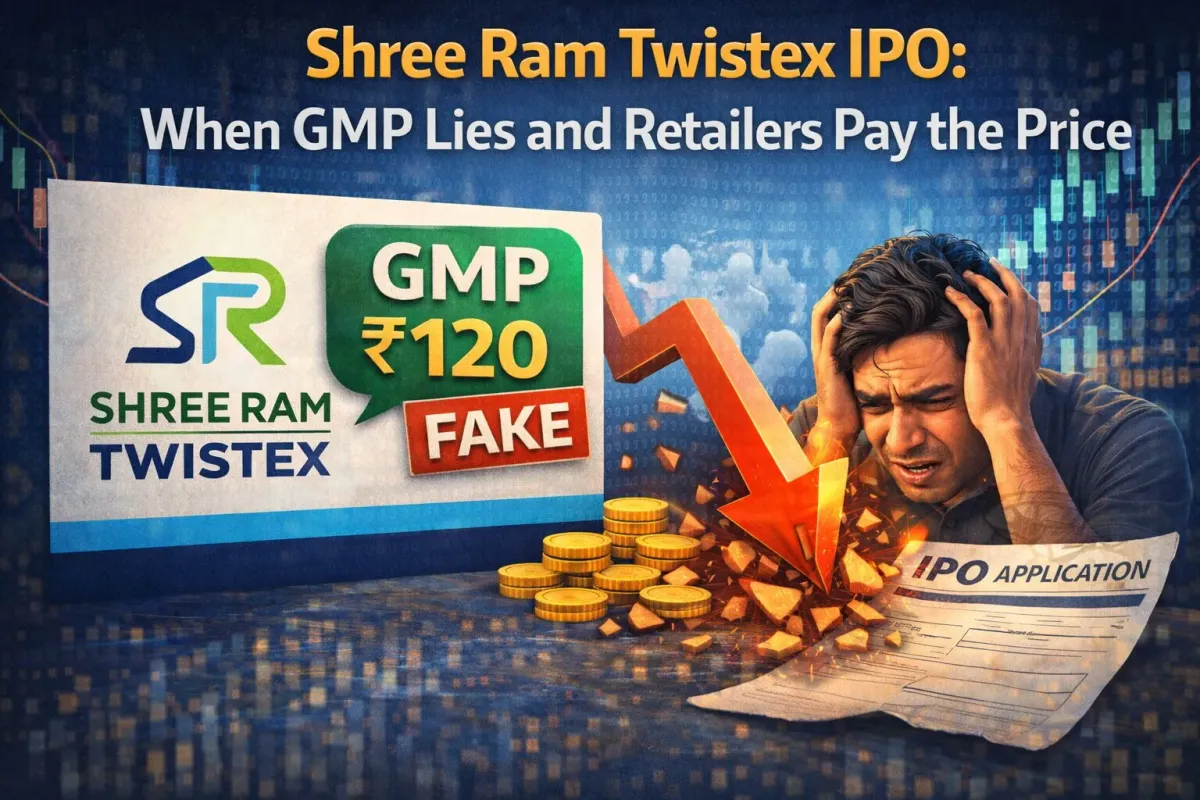
It was supposed to be a quick 17% gain. That's what thousands of retail investors believed when they hit "Apply" on the Shree Ram Twistex IPO on February 25, 2026 — the final day of subscription. The Grey Market Premium (GMP) was showing ₹17 to ₹18 above the issue price of ₹104. WhatsApp groups were buzzing. Telegram channels were screaming "Strong GMP! Apply Now!"
And then, in less than 48 hours, everything collapsed. By listing day — March 2, 2026 — the stock opened at ₹68 on NSE. That's a 34.62% crash from the IPO price. Investors who applied for one lot of 144 shares saw ₹5,184 vanish in the opening seconds of trading. HNIs who had taken loans to apply lost over ₹3.47 lakh per minimum application — before even counting the interest on their borrowed money.
This is the story of how GMP manipulation worked in the Shree Ram Twistex IPO and why thousands of retail investors paid the price for trusting an unregulated number over fundamental analysis.
What Is GMP and Why Do So Many Indians Trust It Blindly?
The Grey Market Premium (GMP) is an unofficial, unregulated market where IPO shares are bought and sold before they officially list on BSE or NSE. Think of it as a black market for IPO shares — no SEBI oversight, no legal protection, no accountability.
In theory, GMP should reflect genuine demand. In practice, it is extremely easy to manipulate — and operators know this very well.
Millions of Indian retail investors use GMP as their primary decision-making signal for IPO applications. If the GMP is high, they apply. If it is low, they skip. This simple heuristic is exactly what operators exploit.
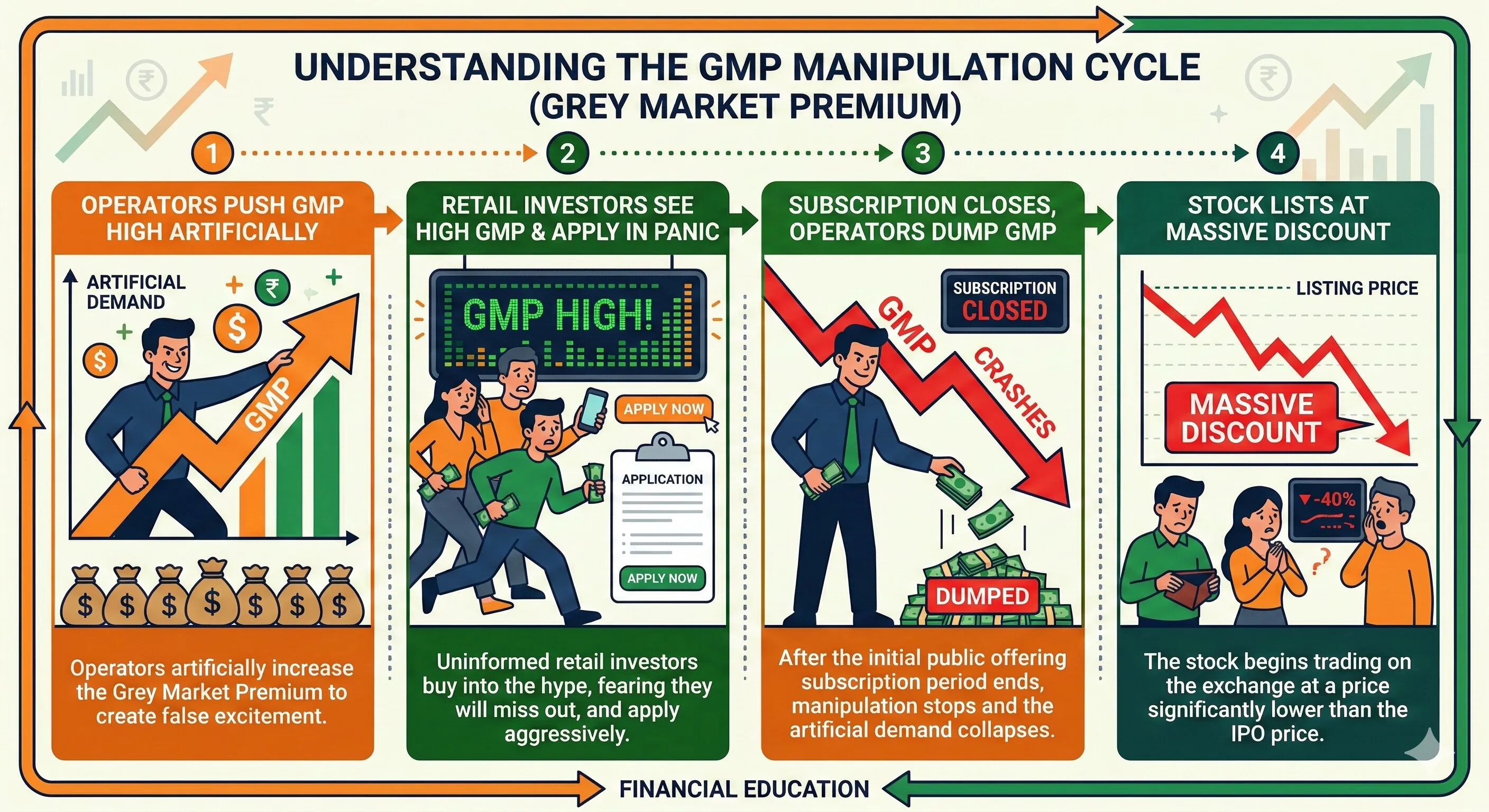
The Shree Ram Twistex GMP Story — Day by Day
Here is exactly how the GMP manipulation unfolded across the three-day subscription window:
Day 1 — February 23, 2026 (Monday) GMP was modest at ₹5 to ₹7.5 per share. This suggested a mild 5–7% listing gain. The issue was subscribed just 0.12 times overall. Crucially, QIBs (big mutual funds and foreign investors) subscribed zero times — a massive warning sign that was completely ignored by retail participants.
Day 2 — February 24, 2026 (Tuesday) Operators began their work. GMP was pushed up to ₹9. Social media channels started talking about "building momentum." Retail subscription ticked up to 2–3.48x. NIIs reached 2.70x. But QIBs? Still zero.
Day 3 — February 25, 2026 (Wednesday — Final Day) This is where the trap was sprung. By morning, GMP was at ₹13.5. By afternoon session, it had spiked to ₹17 and then briefly ₹18 per share — implying a listing price of ₹121 to ₹122 and a gain of 17.3%.
The FOMO (Fear of Missing Out) exploded. Retail investors flooded in. HNIs deployed borrowed capital by the hundreds of crore. By close of subscription, the issue was oversubscribed 43.66 times, with bids worth a staggering ₹4,813 crore for an IPO that only needed ₹110.24 crore.
February 26, 2026 — The Morning After Subscription window was closed. Investor money was locked. And then — the GMP collapsed overnight. By allotment day, the GMP had crashed to negative ₹6, then negative ₹12, then negative ₹20. The same people who were hyping a ₹18 premium were now signalling an ₹84 listing.
March 2, 2026 — Listing Day The stock listed at ₹68 on NSE and ₹70 on BSE. Over one third of investor capital — gone. In seconds.
Why Did Smart Money (QIBs) Refuse to Touch This IPO?
This is the most important question. And the answer tells you everything.
Qualified Institutional Buyers (QIBs) — India's top mutual funds, foreign portfolio investors, insurance companies — subscribed only 3.94 times their allocation. In any strong IPO, QIBs subscribe 50x to 100x. A 3.94x print on a ₹110 crore issue is a near-total rejection.
Why did they stay away? Because they read the Red Herring Prospectus (RHP) carefully:
- The IPO was priced at 38.21 times P/E — shockingly expensive for a small yarn maker with ₹255 crore in annual revenue
- The company's single largest customer generates 62% of total revenue — extreme concentration risk
- The entire business runs from one factory in Gondal, Gujarat — any disruption means zero production
- Margins jumped suspiciously from 8.5% historically to 12.9% in the 6 months just before the IPO — raising accounting integrity concerns
- The ₹39 crore wind power project to be funded by IPO money had no binding construction contract signed yet
- The lead manager, Interactive Financial Services Ltd, had a track record of managing IPOs that listed at discounts
Institutions saw all of this. Retail investors saw only the GMP.

How Much Did Investors Actually Lose?
Let's put real numbers to the damage:
| Investor Type | Money Invested | Value on Listing Day | Loss |
|---|---|---|---|
| Retail (1 lot = 144 shares) | ₹14,976 | ₹9,792 | ₹5,184 |
| HNI / bNII (minimum 67 lots) | ₹10,03,392 | ₹6,56,000 (approx) | ₹3.47+ lakh |
And remember — most HNI investors borrowed money to apply. They were expecting a 15–17% gain to cover their interest costs and make a profit. Instead, they faced a 35% principal loss plus the loan interest. A devastating double blow.
The mass panic-selling by these leveraged HNIs on listing day created a supply flood that ensured the stock could not recover even intraday.
The 5 Red Flags That Were Hiding in Plain Sight
The shocking truth is — every single warning sign was publicly available in the RHP. Here is what retail investors ignored:
- Promoters bought shares at ₹3.33 to ₹6.22 per share. They were offering them to you at ₹104. That's a markup of 15x to 31x.
- QIBs subscribed only 3.94x. When smart institutional money avoids an IPO, ask why.
- One client = 62% of revenue. Lose that relationship and the company is finished.
- Suspicious pre-IPO margin spike. EBITDA went from 8.5% to 12.9% in just 6 months before the IPO.
- No EPC contract for the wind plant that ₹39 crore of your money was supposed to fund.
📖 Also Read: Worst Performing IPOs of India in the Last 10 Years — you'll see the same warning signs repeated across multiple disasters.
How to Protect Yourself From GMP Manipulation in Future IPOs
Here is a simple checklist. Save it. Use it before every IPO application:
✅ Check QIB subscription first. This is your most reliable signal. Below 10x on a small issue = red flag.
✅ Never apply on Day 3 based on GMP alone. GMP can be pumped and dumped within 24 hours.
✅ Check the P/E ratio vs listed peers. If a small company is priced higher than established players, ask why.
✅ Read the top 5 risk factors in the RHP. Takes 10 minutes. Can save you lakhs.
✅ Look at customer concentration. If 1–2 clients = 60%+ of revenue, that's a fragile business.
✅ Check the BRLM's (lead manager's) past IPO performance. A bad track record repeats.
✅ Use live GMP data from trusted sources only. Track real-time and verified IPO GMP data here — not random WhatsApp forwards.
📖 Also Read: 6 Tips and Tricks to Get Confirm IPO Allotment — once you've identified a genuinely good IPO, use these strategies to improve your allotment chances.
The Final Lesson: GMP Is Not a Guarantee
The Shree Ram Twistex IPO is not just one bad story. It is a perfect example of how the Indian IPO market can be manipulated — using psychology, leverage, and an unregulated number called GMP — to extract money from retail investors who never had a fair chance.
The operators who pumped the GMP to ₹18 on Day 3 made their profit. The BRLM collected its fees. The promoters — who acquired shares at ₹3 to ₹6 — got their company valued at ₹415 crore briefly.
The retail investor? Left holding shares worth ₹68 that they paid ₹104 for.
This is the harsh reality of applying in an IPO based on unverified GMP signals without doing even basic fundamental analysis. As India's IPO market grows, these traps will only become more sophisticated.
📖 Before your next IPO application, check the Live IPO Subscription Status and track real GMP on IPO Guru — India's trusted source for primary market data.
📢 Take Action Before It's Too Late
Did you or someone you know apply in the Shree Ram Twistex IPO? Share this article with them — knowledge is the only protection against the next GMP trap.
And if you want to stay ahead of future IPOs — the good ones and the dangerous ones — bookmark IPO Guru and join their WhatsApp channel for real-time GMP alerts, subscription data, and expert analysis that cuts through the noise.
Because in the IPO market, the investor who reads the RHP always beats the investor who reads the GMP.